Creatives should not fear the rise of artificial intelligence
Here at Writing at the Edge we have dived head-first into the artificial intelligence controversy. I reckon it’s not all bad … a view my colleague Jason Mann doesn’t share!
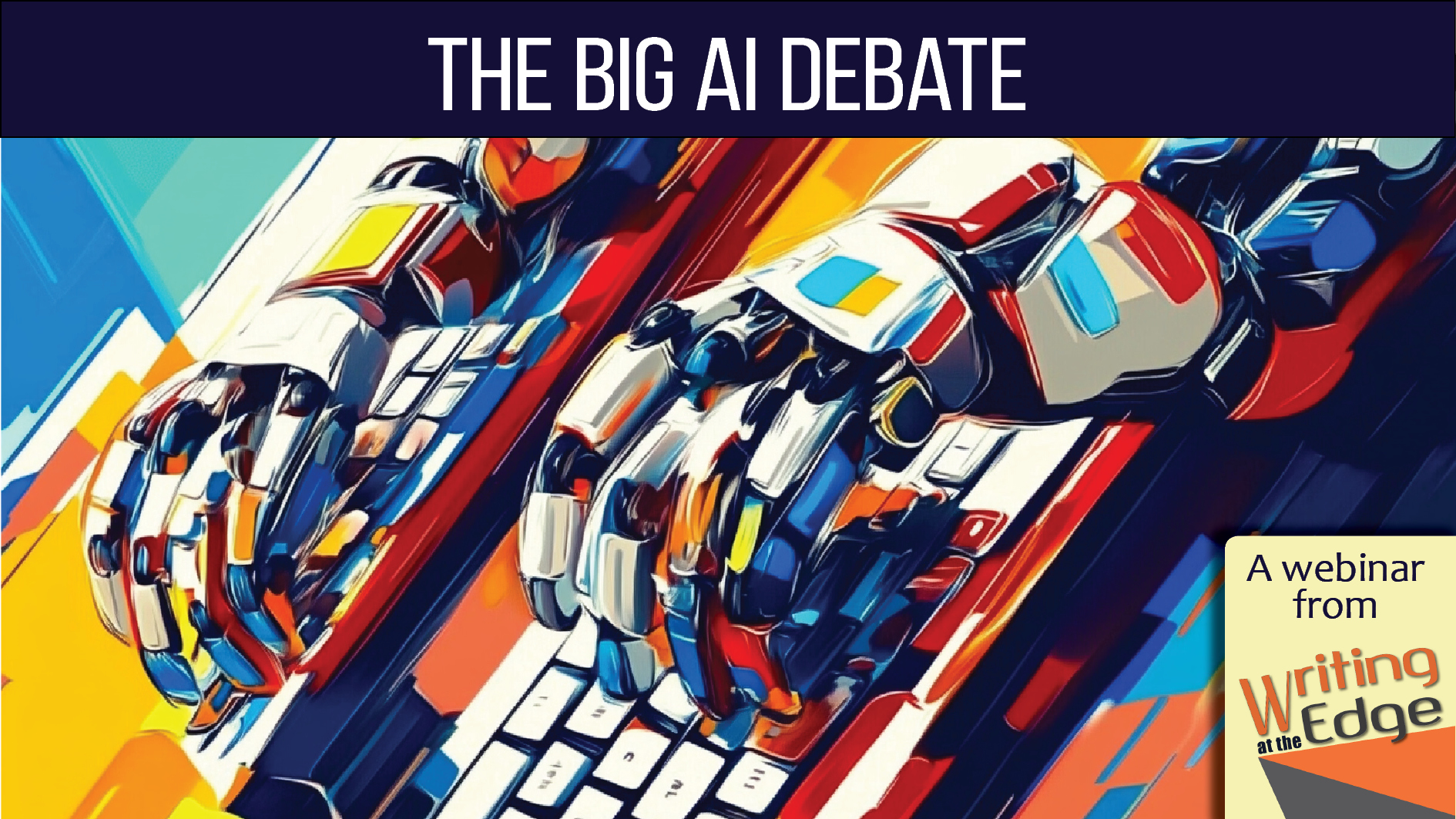
Earlier this month our regular webinar focused on the topic – click here to watch it.
Jason and I followed it up by staging a debate at the South Hams Authors Network where, it’s fair to say, opinion swung a good part of the way in my direction (please leave your own thoughts in the comments on this post).
Before I dive in: Jason and I actually agree on one fundamental point: AI models learn from what has already been written. Just like you, and I and every other human writer did.
Just as we had to buy the books we learned from, so yes, AI companies must be made to pay the original creators. No question.
Copyright is not some quaint old relic we dust off when we want to be nostalgic—it’s the legal and moral backbone of our profession. And governments should not gut it just to fatten up a few Silicon Valley unicorns.
Taking our work for free is stealing.
But let’s also be honest: AI is not going away. You can’t uninvent it. Pandora’s box has not only been opened—it’s been livestreamed, memed, and integrated into Microsoft Word.
So, what do we do?
Some creatives have chosen to panic. To wring their hands in existential dread. To post anguished tweets at three in the morning. I suggest we stop doing that. Not because the concerns aren’t real, but because the public is watching. And what they see is a roomful of artists
afraid of a tool.
Here’s what I propose instead: we own the narrative.
We remind the world that human-made art has depth. That creativity isn’t just about output, it’s about intention, emotion, lived experience. We tell readers, viewers, and listeners: “Yes, you can buy the AI-generated novel for £1.99—or you can pay a little more and experience something only a living, flawed, fascinating human being could have created.”
And then we live up to that promise. We get better. Sharper. More inventive. If AI raises the bar, we meet it—and vault over it.
Every creative generation has had its own so-called doomsday device: photography was going to kill painting, TV was going to destroy cinema, self-publishing was supposed to flood the market with rubbish. And yet, here we all are—publishing, creating, storytelling like mad.
And let’s be real—many of us wouldn’t even be here if not for the tech Jason’s so worried about. Amazon, Ingram Spark, Canva—tools that once horrified traditionalists are now the reason some of us got published at all.
Traditionally writers had to negotiate their way past the gatekeepers – the agents and editors. Tools such as Amazon helped to remove those gatekeepers – sometimes with good results sometimes with bad. Every change has good and bad in it.
The kind of control and legislation Jason argues for would simply impose new gatekeepers on creativity, and that would be a step backwards.
Now, I don’t use AI to write. That’s my job. That’s the fun part. But I do use it. For research, for building characters visually. I’ve created more than 40 illustrations for my middle grade novel—Shadow Lands: The Poacher’s Trap—with the help of Midjourney. Not because I wanted to cheat an illustrator out of work, but because I couldn’t afford one. Without AI, the book simply wouldn’t exist.
And don’t be fooled into thinking I’m just typing “give me a picture” and clicking download. Some of those illustrations were blends of nine or ten separate images from Midjourney, created through hours of work on Photoshop and Adobe Illustrator. It’s not cheating—it’s craftsmanship.
So, to answer the real question: What is creativity for?
I say this: I create for an audience. I tell stories that people want to hear. And if one day that audience genuinely can’t tell—or doesn’t care—whether the story came from a human or an algorithm, then we’re not arguing about tools anymore. We’re arguing about taste. And in that battle, may the best story win.
Jason is quite right – AI is a threat to all of us in this room. And perhaps that’s because we’ve become complacent.
The number of people who read books has been falling for years, and whose fault is that? No one is compelled to read fiction – it’s up to us to make them want to.
I believe that AI will drive a new burst of creativity among humans. Our species has always risen to challenges and it’s hard to accept the idea that a computer algorithm will finally floor us.
Perhaps one of the people reading this post will discover that new paradigm of creativity … probably not. More likely, it will be someone not yet born.
For today, human creativity still has the edge. Still makes people cry, laugh, fall in love. AI can mimic—brilliantly at times—but it doesn’t know why. That’s our advantage. And it’s a good one. For now.
But we cannot hope to legislate our way out of the challenge – we can only tackle it head-on.
We should not try to install new gatekeepers to creativity.
You can sign up for out FREE webinars on the craft and business of fiction writing by clicking on the Ticket Tailor link below: