
The BBC is giving ammunition to its enemies
Grrr. Does the BBC never learn?
Hot on the heels of that poorly edited Trump interview, Auntie has been at it again – this time with Google’s Sundar Pichai and the warning of an “AI bubble”.
On the Radio 4 Today programme on Tuesday 18 November 2025, the headline I heard went something like:
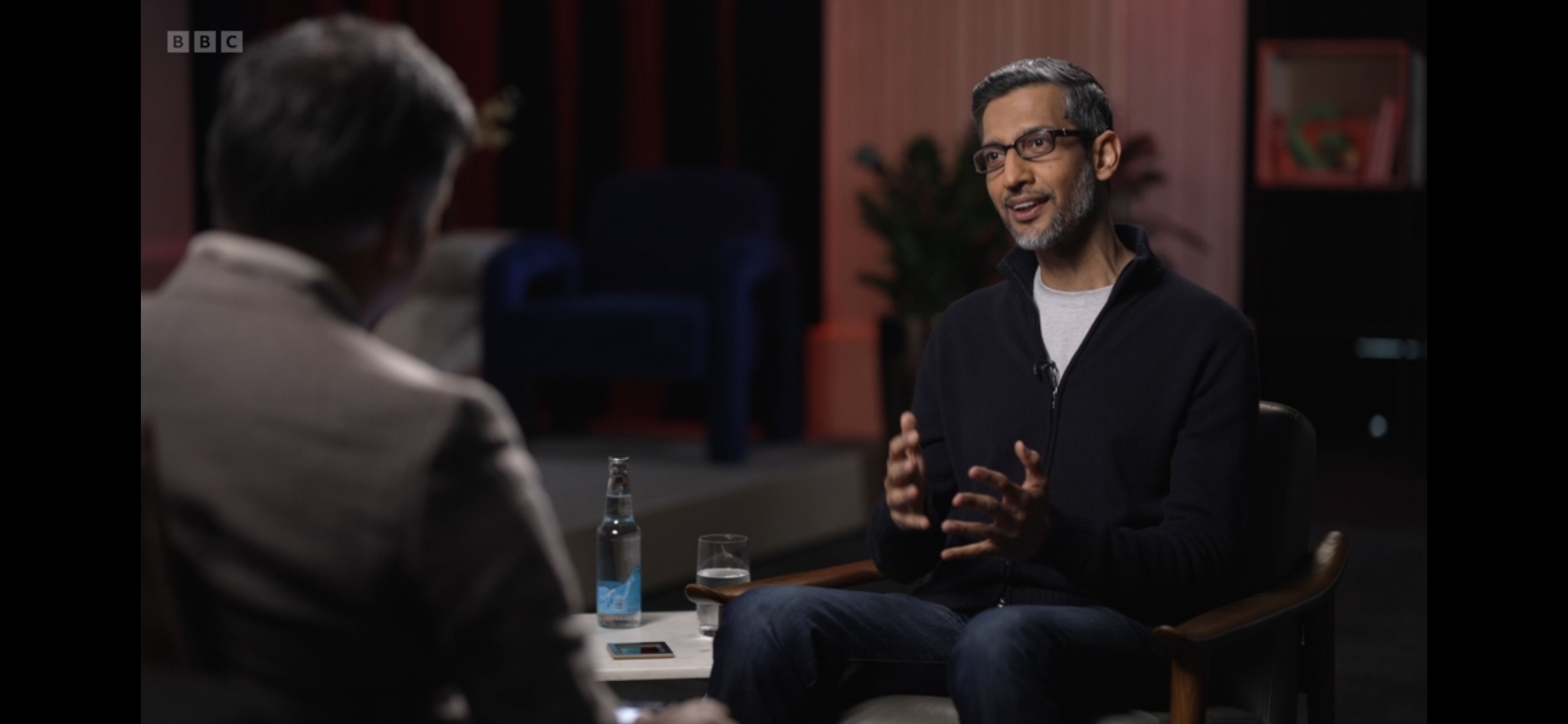
“Google boss says every company would be affected if the AI bubble were to burst.”
“Oh no, we’re all doomed,” I thought. If every company on Earth is in mortal danger from an AI crash, that’s not just a business story – that’s “Fall of the Roman Empire 2: This Time It’s Digital”.
The same line appeared on the BBC’s shiny news app.
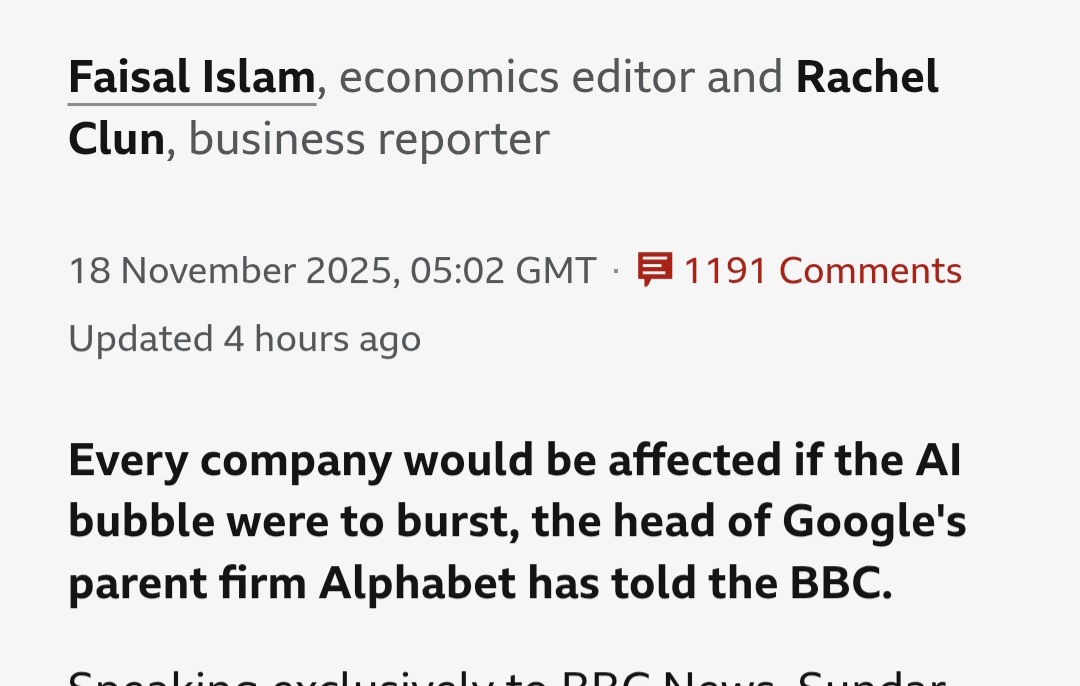
Fair enough, if that’s what he actually said.
But it isn’t.
A few minutes later they played a clip from the interview. What Pichai actually says is:
“I think no company is going to be immune, including us, if you over-invest.”
Those last three words – if you over-invest – change the meaning entirely. It’s no longer “AI bubble threatens civilisation”; it’s “don’t be greedy and reckless”. Sensible advice, not apocalyptic prophecy.
You can hear the full version yourself on iPlayer at about 4:22 into the programme.
This isn’t the end of the world, but it is the sort of sloppy editing that slowly corrodes trust. And trust is the only real currency a public broadcaster has.
The Aunt with bad habits
I say all this as someone who has a deep, slightly sentimental affection for the BBC.
We grew up with Auntie. She read us bedtime stories on Jackanory, scared us witless with Doctor Who, soothed us with Radio 4 drama and later introduced us to some of the cleverest comedy and most ambitious storytelling anywhere in the world.
But Auntie is developing some seriously bad habits in her dotage.
Clipped quotes. Overheated headlines. That slightly desperate whiff of “Please click me, I can be outrageous too!” which used to be the preserve of the more excitable corners of Fleet Street.
I understand why it’s happening. The over-commercialisation of broadcasting has left scores of barely profitable TV channels, radio stations and digital platforms all scrabbling for the same eyeballs. More platforms haven’t magically produced more money; they’ve just sliced the pie into thinner and thinner wedges.
You might imagine that more outlets would mean more work for writers, but of course what it often means is more people trying to live on fragments of the old budgets. In that environment, the temptation to crank up the drama in a headline is strong.
Still. The BBC is supposed to be the grown-up in the room.
The nursery of national treasures
Part of the reason this hurts is that the BBC has been one of the great nurseries of writing talent in this country. It still is, at its best.
Take Douglas Adams. The Hitchhiker’s Guide to the Galaxy didn’t begin life as the cult novel, or the TV series, or the film. It started as a BBC Radio 4 comedy in 1978 – an experimental, slightly bonkers science-fiction show that the Corporation nevertheless took a punt on.
Or look at Lee Hall. His playwriting career was effectively launched when his radio drama Spoonface Steinberg was broadcast on BBC Radio 4 in 1997; it became a phenomenon, and Hall went on to write the screenplay for Billy Elliot and a string of acclaimed stage plays.
Long before Catastrophe and Bad Sisters, Sharon Horgan was sending sketches to the BBC and won the BBC New Comedy Award for sketch writing in 2001 – her first major break as a writer-performer.
That’s the BBC at its best: patient, curious, willing to back oddballs and outsiders and give them just enough airtime to change the culture.
It’s not hard to imagine that, in another era, a bunch of Cambridge graduates who liked dressing up and being silly – the Monty Python team – might have looked at today’s fractured, underfunded media landscape and thought: “You know what, maybe we’ll stick with law and medicine.”
Why this matters now
All of which is why these careless little tweaks to quotes annoy me so much.
The BBC has plenty of enemies for whom “defund the Beeb” is a hobby-horse. Some are driven by ideology, others by commercial interest. Either way, they’re delighted whenever the Corporation hands them a free kick in front of an open goal.
If you’re going to stand up in public and say, “We are the trusted source in a world of misinformation,” then you simply can’t afford to shave off the awkward bits of quotes to make your headline more spicy.
I want a strong, confident, slightly eccentric BBC that still has time for risky writers, late-night radio plays and quietly brilliant experiments. I want an Auntie who can look the social-media outrage machine in the eye and say, “No thanks, dear, I’m fine with being accurate.”